🔎 Time DOESN'T heal:<br>What the science actually says on happiness, relationships, and growth
Feb 06, 2026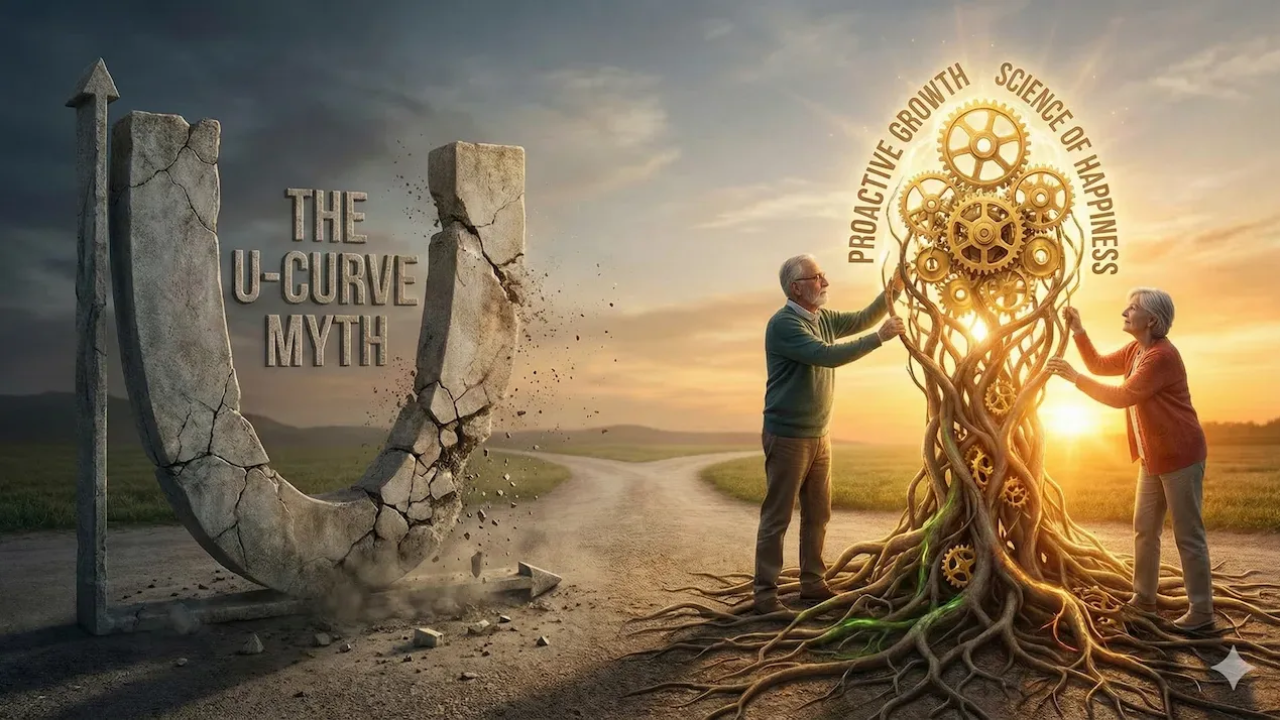
By Eldad Ben-Moshe ✨ Reading Time: 4 minutes
I've been deep in the academic trenches lately for my Master's degree,
and I found researches that shattered a "scientific" myth about love, happiness, and life itself.
You know the story of the "U-Shaped Curve"?
For decades,
the dominant narrative regarding marital satisfaction has been the "U-shaped curve" -
high satisfaction at the beginning, a decline during child-rearing, and a recovery in later life (see reference 1).
It's the comforting idea,
that became the leading belief even amongst therapists,
that marriage follows a predictable path:
You start happy,
then life gets messy (kids, career, stress) and you hit rock bottom,
but if you wait,
your happiness will magically shoot back up in your golden years -
just because time passed and circumstances changed.
Here is the hard truth I found in the data: That is a lie.
Current research that gathered data over long periods of time shows that for many people,
satisfaction doesn't just bounce back because time passed (1,2).
If you put your relationship - or your life - on autopilot and just "wait for things to get better,"
they usually stay as they are - with the problems and all -
or fall apart.
Time is not a healer.
Time is just a measurement.
The couples who do find that deep, rich happiness later in life?
They didn't get there by waiting.
They got there by proactively doing what it takes.
Here is what the science actually says, and it applies not only to marriages:
1. It's not just gradual:
The biggest changes in happiness don't happen gradually;
They are big, sharp changes that happen when we hit massive "transition points" - l
ike the sudden chaos and joy of becoming parents, becoming empty nesters, etc. (3,4,5)
2. Crumbling vs. thriving:
The relationships (and people) who crumble are the ones trying to keep their old life alive.
The ones who thrive?
They accept that the old system is broken and actively build a new one.
3. "Expansion" is the secret sauce:
The happiest older couples aren't just roommates; they actively engage in "self-expansion".
They push each other to find new hobbies, new passions, and new growth.(5,6)
They don't shrink into retirement -
they expand into it.
4. You MUST do this for it to work:
Take the empty nesters myth, for example:
Society tells us we'll be sad when the kids leave.
Personally, even though I have 50% of custody of my son and I'm not even a full-time empty nester -
I feel it every week as he goes to his mom.
Trust me, the sadness and emptiness are real.
But the data (and what I've been teaching for decades) says that just like any other crisis,
this too is a massive opportunity for a happiness spike -
But only if you use it for that.
It takes proactive decisions and actions.(7)
You must do that for it to work.
It won't just happen on its own because of some theory about a U-shaped timing.
In the empty-nest couple example,
it's not about "oh that time has come and now the U shape will go up just because the time passed."
It's not enough that you have more quantity of time together-
It takes proactive decisions and actions that increase the quality of time you spend together.(7)
For example, the decision to date again (and take those actions),
not just being roommates in a quiet house.
The Bigger Lesson: This Isn't Just About Marriage
This is one of the core truths I always implemented with my coaching clients and taught in my courses at Better Life Awareness Center;
And whether it's your marriage, your business, or your spiritual path, the rule is the same:
1. Growth and a better life do not come by being passive.
They come from proactive decisions and actions.
2. The crisis is a wake-up call.
I like saying it this way:
Nobody wants to wake up from a nice dream.
It's the nightmares that make us want to wake up.
So either sooner or later,
while the dream is nice or once it becomes a nightmare...
You'll realize things changed;
that the old reality is no more,
or that it is broken,
and you'll need to either actively and consciously build a new one and create a happier, better life -
or crumble and drown.
We often trick ourselves into thinking,
"I'll focus on my personal growth once the kids are older,"
or "I'll find my passion once work slows down,"
or "I'll start my diet tomorrow, I'll eat what I want just one more day".
But the research screams the opposite.
The "crisis" moments - the stress, the role strain, the divorce, the empty nest - aren't obstacles to your growth.
They feel like that because they are not the way you wanted things to be (for more about that, check the B-AIR guide).
They are the mechanism of your growth -
but only if you choose to use them for that.
The 2nd exercise in the workbook of A Course in Miracles teaches us that we have given everything all the meaning that it has for us.
The purpose and meaning you give things, including life events, are critical.
They'll be to you what you choose to use them for.
And whether you're aware of it or not, it's your choice, including not choosing and "just letting it be whatever."
Even Newton Agrees!
Here's a short story that happened shortly after I wrote all of the above,
and illustrates this perfectly from yet another scientific angle:
My 6-year-old son is absolutely obsessed with soccer and is crazy good at it.
I'm talking 12-goals-in-his-last-game crazy good at it!
(and 1 assist. It ended 16-2.)
Recently, he brought home a book from the school's library explaining soccer.
To my surprise, it explained it through physics!
I didn't expect that from a school that goes only to 3rd grade.
He's also super smart (I know how this sounds like 🤣... but it's true 🤷♂️),
so I wasn't too surprised that he understood the general ideas presented in the book,
as much as he can at 6 years old - including things like Newton's laws of motion.
And as I was reading the book to him and helping him understand it,
things clicked in my mind about how perfectly this connects to what I shared with you above.
Think about Newton's First Law of Motion, often called the Law of Inertia:
An object in motion stays in motion with the same speed and in the same direction (constant velocity) unless acted upon by an unbalanced external force.
Above, I talked about how we often treat our happiness and relationships like they are on autopilot:
We believe the myth of the "U-shaped curve" -
that if we just wait long enough,
things will naturally get better on their own.
And if we don't believe in it, we at the very least hope that it's true.
But Newton's law -
NOT some fluffy made-up new-age B.S. "law" like "manifestation" -
reminds us that's not how the universe works:
Just like his First Law of Motion,
If your relationship or life satisfaction is heading in a certain direction (or just standing still),
it will stay on that trajectory unless you apply an "unbalanced external force".
In other words,
unless you take proactive action to change it,
things will keep going downhill.
Time alone doesn't change the direction - YOU do.
If you want to see real, long-lasting changes in your life?
You'd better take relevant action to make them happen.
You'd better become the "external force" that will re-route your life,
because otherwise, as Newton's First Law of Motion said...
It'll only keep getting worse.
From information to transformation:
Practical actionable steps you might want to take right now
Don't wait for the relationship, or life, to get easier.
It won't.
Not on its own.
Instead:
- Face the truth of how things are now.
- Make decisions based on the truth as it really is right now - not how it used to be or what you want it to be.
- Take action accordingly.
- Use the painful events to learn how to live better right now; how to have the happier, better, more awakened life you want and deserve.
- Use everything that happens in life to grow.
.
The "U-Curve" approach implies you are a passive passenger on a bus ride,
and that the next, better stop will arrive someday, on its own, just because time passed, if you only hang in there long enough.
It won't.
Just like that diet won't start on its own tomorrow.
If you want a happier, better life,
stop being a passive passenger.
Hope is critical psychologically,
but on its own,
it's not a good strategy if you want to see changes.
Instead, you can choose to change buses and change the destination you're heading towards.
It's up to you to change the trajectory of your life.
Stop waiting for the U shape to finally get to the upswing.
Go create it.
* References:
(1) VanLaningham, J., Johnson, D. R., & Amato, P. R. (2001). Marital happiness, marital duration, and the U-shaped curve: Evidence from a five-wave panel study. Social Forces, 79(4), 1313–1341.
(2) Karney, B. R., & Bradbury, T. N. (2020). Research on marital satisfaction and stability in the 2010s: Challenging conventional wisdom. Journal of Marriage and Family, 82(1), 100–117.
(3) American Association for Marriage and Family Therapy. (n.d.). Marital distress. Retrieved January 23, 2026, from https://www.aamft.org/Consumer_Updates/Marital_Distress.aspx
(4) Doss, B. D., Rhoades, G. K., Stanley, S. M., & Markman, H. J. (2009). The effect of the transition to parenthood on relationship quality: An 8-year prospective study. Journal of Personality and Social Psychology, 96(3), 601–619.
(5) McGoldrick, M., Carter, B., & Garcia Preto, N. (2016). Overview: The life cycle in its changing context. In M. McGoldrick, N. Garcia Preto, & B. Carter (Eds.), The expanding family life cycle: Individual, family, and social perspectives (5th ed., pp.1–44). Pearson.
(6) Culver, J. L., & Gordon, C. L. (2020). Growing into retirement: Longitudinal evidence for the importance of partner support for self-expansion. Psychology and Aging, 35(7), 1041–1049.
(7) Gorchoff, S. M., John, O. P., & Helson, R. (2008). Contextualizing change in marital satisfaction during middle age: An 18-year longitudinal study. Psychological Science, 19(11), 1194–1200.

Author